
 RSS Feed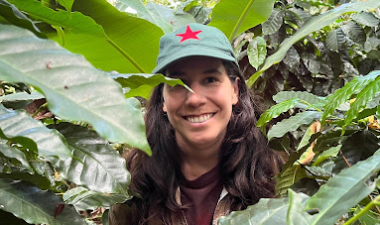
The University Library is pleased to introduce Megan Gross as the recipient of the 2026-2027 Fellowship in the Center for Archival Research and Training (CART).
Megan is going into her third year as a PhD student in Environmental Studies, where her research focuses on the politics of knowledge in the science, practice, and social movement of agroecology. Prior to her time at UC Santa Cruz, she worked in communications, farming, and community-based work, and eventually returned to school for a Masters in Environmental Justice at the University of Michigan.
When she begins her fellowship this fall, Megan will be immersed in Special Collections & Archives for a full academic year, devoting 20 hours per week to archives and public projects in the library. Megan will organize and describe the records of UCSC’s Center for Agroecology as well as the papers of Steve Gliessman, UCSC professor emeritus of Environmental Studies. After making these collections available for research, she'll curate an exhibition that will open in the McHenry Third Floor Gallery in Spring 2027, and plan a program for the campus community.
Stay tuned for more information on Megan’s work throughout the year!
Meet Megan
Tell us a little bit about your background. How did you decide to come to UCSC for your graduate studies?
I came to graduate studies through a somewhat circuitous route. After graduating from college I worked in lots of different fields, from radio and data analytics to farming, and eventually to directing a small food justice nonprofit at the onset of the pandemic. That experience in particular shaped the questions I pursue now, particularly around abolitionist approaches to taking down industrial agriculture, transnational solidarity-building, and who gets to define what counts as legitimate knowledge in food systems. But honestly, to me research and teaching are just two small, limited tools. Taking my commitments to fighting for food sovereignty into the academic realm is just one way I felt I could broaden my capacity to build relationships and communicate across the many dimensions of food system transformation.
After leaving the nonprofit, I first went to the University of Michigan for a master’s in Environmental Justice where I had the opportunity to work with Dr. Ivette Perfecto, who kindly welcomed me into the vibrant and entangled matrix of agroecological science and social movements, from Detroit to her home in Puerto Rico. Thanks to her, I also came to know or got exposure to incredible politically-engaged scholars such as my current advisor at UCSC, Dr. Maywa Montenegro, and Dr. Stacy Philpott, the faculty director for the Center for Agroecology. UCSC is one of the few academic hubs for agroecology in the U.S., and it’s played a key role in contemporary constructions of agroecology—especially as they pertain to science. That’s why it’s an excellent home for work like Maywa’s which sits at this really exciting intersection of science and technology studies, agroecology, and questions of power and knowledge. I knew this is where I could both learn the most and also be free to incorporate many disciplines and ways of knowing.
You’ve done a lot of work around food systems and food justice both inside and outside of academia, could you talk more about that? What do you think would surprise most people about your work?
That’s kind of you to say. Honestly, I still experience some internal friction between how I participate and how I hope to, but I am grateful to be here and eager to keep learning. As I alluded to above, I have played lots of roles in lots of corners of food systems work from working as a farmhand on an organic production farm to managing Community Shared Agriculture programs (CSAs), to eventually working for a nonprofit where I directed free breakfast programs, bilingual educational curricula, seed swaps, and an urban garden commons. But folks might be surprised that in college I worked in the consumer packaged goods space and briefly interned at a tahini start-up that has now revealed itself to be Zionist, which I deeply regret. I’ve arrived at a place where I am firm in my beliefs and knowledge about where food sovereignty and justice intersect, and I have a much more critical understanding of overt and covert violence within our relationships to food. Agroecology is a really grounding space to forward emancipatory commitments to food systems transformation away from systems of oppression, but it too can be co-opted. That’s why the history of all of this meaning making is so important and why I’m stoked to dive into the archives of agroecology here at UCSC.
There are also more pleasant surprises to my work I am sure. For example, “research” for me has looked like all kinds of things from planting coconut palms on work brigades in Puerto Rico to line-by-line analyzing court proceedings from international trade disputes. Because so much of my life is related to my "research," the bounds of fieldwork are vast and flexible, and I really love that.
How did you hear about CART, and what attracted you to the fellowship?
Just about everyone I know forwarded me the announcement because this year’s archives are so relevant to my work! But beyond my interest in the contents of the archive, I am hungry to learn archival methodological approaches. The CART fellowship seems like an ideal framework to learn with and from archivists and librarians and to develop a collaborative, multitextual practice.
I am also super curious about what isn’t present in the archive. I am particularly eager to trace the transnational dimensions within these collections, such as Gliessman’s work in Mexico and collaborations between U.S. universities and Latin American movement networks—while also looking beyond the main texts to uncover what Katherine McKittrick calls "specters of witness," including the labor histories and racialized ecologies often omitted from institutional narratives. I am excited to approach these archives as active sites of continuous knowledge.
What are some of your favorite things to do outside of your studies and work?
I really just love to play outside, be it hiking, sports, or just walking around, and more recently I’ve been helping to organize work brigades for farmers nearby. I also enjoy drawing, listening to music, cooking for friends, and talking to strangers.
The Elisabeth Remak-Honnef Center for Archival Research and Training (CART), established in 2014 at the UC Santa Cruz University Library, has trained dozens of graduate students in archives and exhibition work since its inception. In cultivating impactful learning experiences, CART develops students' archival research skills to support their career success, and increases access to unique Library resources for all.
 1156 High Street


